You touch me

I was walking down the corridor in a clinic and a middle-aged Aboriginal man called out to me from a colleague’s room, “Hey Doc, I want to see you!” I explained that the very proficient and careful younger doctor that was attending to him was as good as me. He said, “I know, but you touch me.” It was not something I had been told before, and I contemplated a range of interpretations: did I connect to him emotionally; was I more intimate; or did I examine him, perhaps more thoroughly?

There is a wealth of literature on this subject perhaps best summarised in a TED talk by Dr Abraham Verghese “A doctor’s touch“. Every family has stories that demonstrate this fundamentally important aspect of medical care and there are popular medical aphorisms such as “if you don’t put your finger in it, you’ll put your foot in it”. Health practitioners know it is important, but….

There are a number of forces rising against medical examination that offer relief to the uncomfortable doctor or nurse and their patient, both concerned about social boundaries that may be crossed, or the possible experience of emotional or physical discomfort. First is the rise of ‘tests’ which provide detailed internal images which can be wholly reassuring if normal or biochemical measurements are incompatible with disease, thus avoiding the need to see and feel what might be going on. Second, the increase in a general ‘hypochondriasis’ which involves less than perfect wellness, where examination is redundant as only esoteric genetic, enzyme or protein tests will reveal the minor malady and enable (largely) dietary adjustments. How ‘nice’ to be at a comfortable distance and really get to the core issue while avoiding any embarrassment. It is a dangerous collusion.

One person I saw recently really brought to light this issue. A middle-aged man with right sided chest pain had been seen on a number of occasions in various settings over a period of more than a year. His records and the way he presented with yet further pain, despite two normal CT scans done over a year apart (the second one a few weeks ago), suggested that he was seeking pain medication, perhaps even for illicit use. I checked his story, and his tests. “Well,” I thought, “I owe it to him to examine him carefully if I am going to deny him pain relief”.

Sitting one to two meters away, I asked him to take his shirt off. There in the middle of the right side of his chest was a large lump – perhaps 10cm in diameter. I did not need a CT or any other test to know this was grossly abnormal. I am not an expert at reading CT Scans but I looked up the films. There it was, very obvious to the novice radiologist, and yet the CT Scan was reported as normal! How could that be? I rang the radiologist, who concurred – and then checking the previous CT scan revealed that it was present, although smaller, over a year before. No excuses. Both scans were reported as normal. Here I was, looking from a distance of a little over a meter (with my glasses on admittedly) and detecting something that was not picked up on two expensive scans and perhaps as many as 6 attendances for nursing and medical assessment.

Examining him further, he had widespread sounds in his right lung; evidence that the pain he was experiencing was preventing him breathing fully. He had had a couple of chest infections as a result. With a little advocacy he is now getting the care he needs.

I have many experiences where people want to be examined but have found it difficult to get someone to do so. I do wonder if the increase in post-graduate training for doctors, where older medical students already socialised as adults find it more difficult to cross the major social boundaries necessary to be an effective doctor. Added to this are the concerns of litigation for inappropriate intimate examinations and the rise of gender preference; all both excuse and press for avoiding examination. The sexualisation of children has led to even young prepubertal girls feeling uncomfortable having their chests examined. We can only wonder what it was that led to nobody exposing this man’s chest during examination.

On reflection I am proud that I touch people and want other doctors to feel the same comfort with doing a job well. Our patients want high quality care, even if a little reluctant at times to go through some embarrassment. A young woman with an urgent health concern passing through Alice Springs recently had been to the emergency department and wanted to be sure what was wrong. When I explained that examining her would help sort out what was wrong, and asked if she wanted me to examine her, she replied in a relieved voice, “Please”. An old Aboriginal man with limited English, when I explained to be sure about his prostate I would need to put my finger in his bottom, looked at me and my raised index finger and said while looking at my finger, “I want that one”.

I hope young doctors and nurses will realise how important it is to examine people, and I hope people seeking health care will also expect to be examined thoroughly, even demand it if there is clear value. Clothes need to come off to see the region and even the surface changes. Breast and genital examination are not required in many instances and always need careful explanation and consent if not requested. When the need is high, even major cultural barriers will come down to enable adequate health care. The rise of point of care ultrasound and testing in the hands of primary care practitioners will mean more people will have access to tests, but the eyes, ears, nose and especially touch of the practitioner are all rapid information gatherers of very significant value.

Registration status on view

I have been advocating in the Northern Territory for changes in the way doctors present themselves to patients. I want to see transparency of a doctor’s registration status so that patients are aware of who is working under supervision and the name of that doctor’s supervisor. That way patients can escalate any issues to a supervisor if they are not satisfied with the care they are being offered.

Currently in Australia patients have to go to the AHPRA website and look up their doctor. Also, the doctor’s supervisor is not named on that site. How are patients to know who they are dealing with?

I propose the use of 3 colours – red, orange and green – to represent registration status based on supervision requirements. These would have the following meaning:

transparency-in-registration

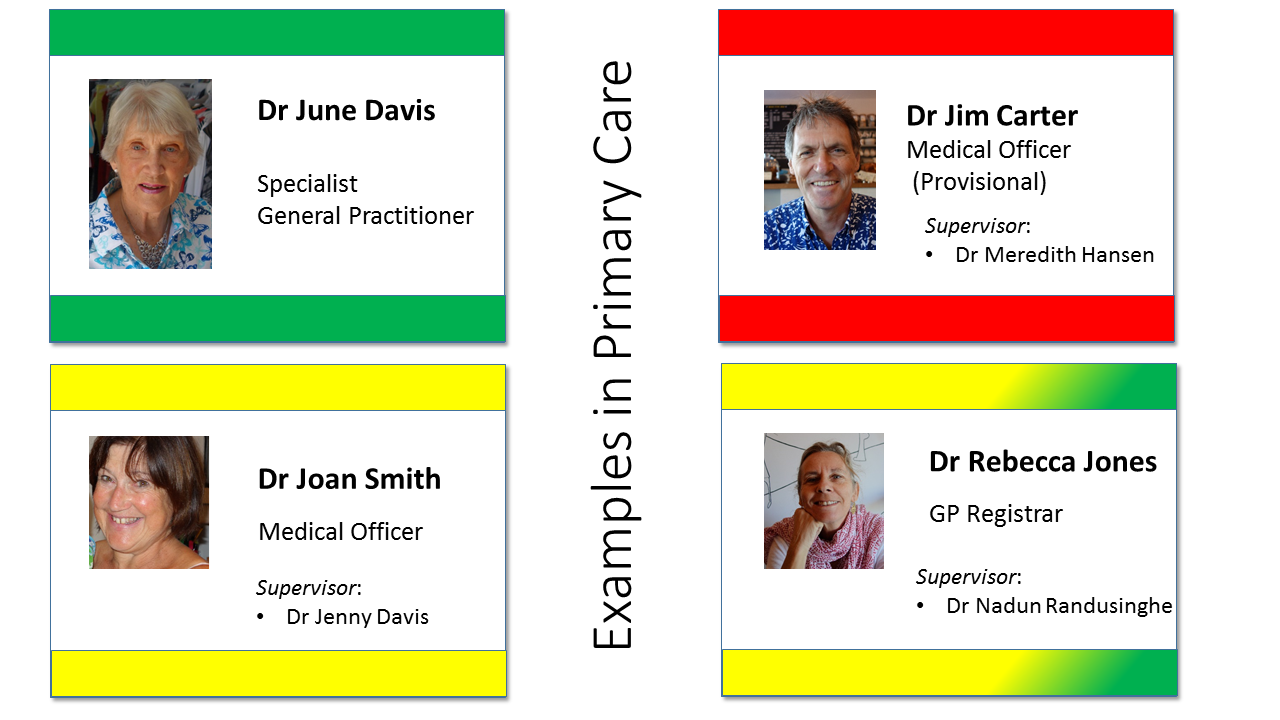
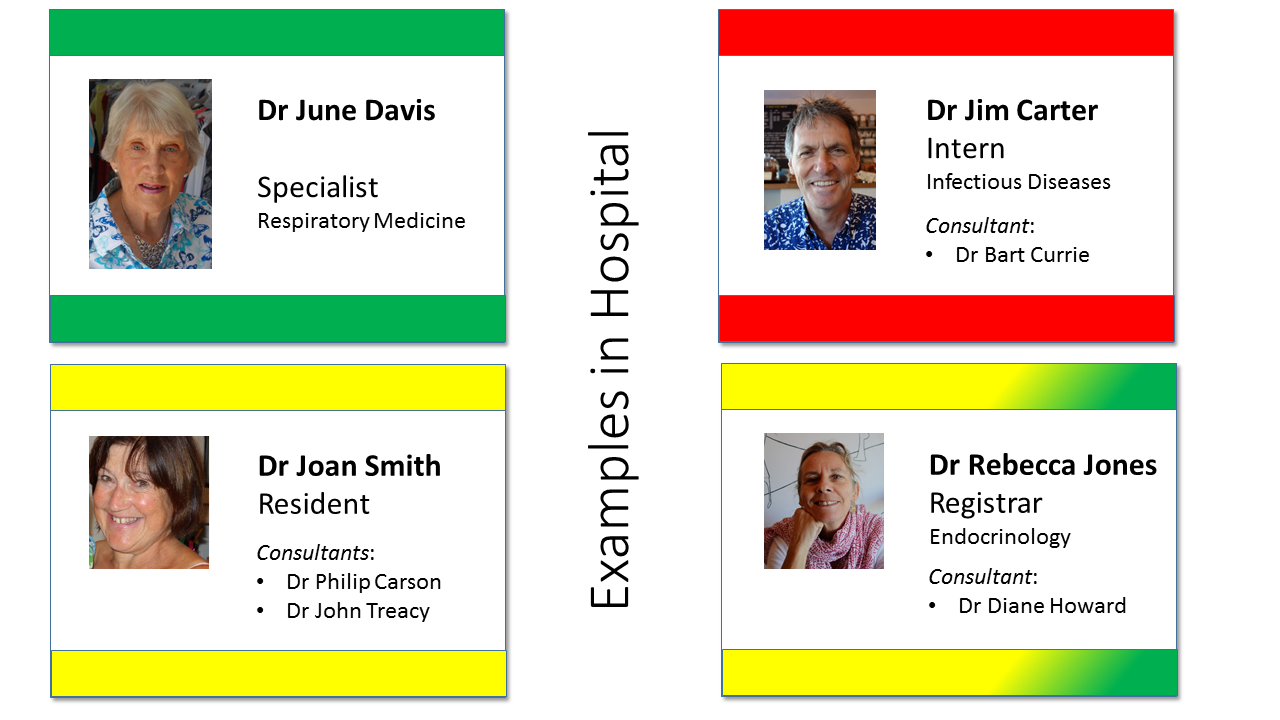
Doctors accepted into a formal training program would be recognised by a mixture of yellow and green.

Badges might look like this in hospitals:

transparency-in-registration-hospital

And like this in primary care:

transparency-in-registration-primary-care

In general practice the colours could be on the name tag on the door rather than on a badge. The point is that patients could understand where we all fit into the world of medicine, whether in hospital or primary care.

Let’s make it clear for patients. The current universal response by doctors to this challenge is that patients have “no idea about the registration status of doctors”. Well, who is to blame for that? I am certain that they want to know.


The doctor’s concern is the patient’s fear

River Bed
Katherine River
How often have you listened to a patient’s story and thought, “OMG! This person has a brain tumour.” After a few more minutes listening (if you are into that sort of thing) your concern might have developed into a mere brain abscess or perhaps a cerebral vascular abnormality. Reacting directly to such gut responses is one reason that doctors now do so many CT Scans of peoples’ brains. I am ashamed to admit that we now cause more brain tumours than we detect. That is clearly not good for our patients and the public purse. In fact, it is a disgrace.

So what should we do with this concern that patients so easily generate in our viscera? We ignore it at our peril for we do not know if it is based on reality, searching google and incorporating the symptoms, a grief reaction to the death of a loved one or even just chance. Whatever turns out to be the case, if the patient was not fearful before telling us their story, they will be after they witness our response. 

What I am saying is – the doctor’s concern and the patient’s fear is the same thing. Singular. One. 

 There is a solution. To respond as a professional rather than as a social being. The neighbour, friend or chat room acquaintance will stay with the patient’s fear – “You need a CT Scan my friend”. As a doctor you can feel and acknowledge the concern, either internally or openly with the patient, and recognising that it is probable that the patient is afraid of whatever you have become concerned about. Now park that concern and go about your professional business.  You can continue gently with the history gathering information that might confirm or refute the possible calamity and examine the person carefully. I cannot stress enough the need to examine people carefully if you are going to refute their fear and explain the symptoms another way. The laying on of hands shows care and attention to detail and justifies our professional opinion.

There is still work to do but investigation is not usually helpful if you do not think it will change the management. Investigation may mean an easy life for you and the patient might attend less in the short term. But the patient has proven that they were right to be afraid and shown that the doctor needed to do a test in order to discover that the feared condition was not present. What is that patient to do when the symptom recurs? How long is a reasonable gap before the test is required again as the doctor is unable to allay the fear without the result? It is a bit like the acceptable period before a widow or widower takes a new partner: there is a wide variety of opinion and a lot of gossip.

 Once in a while, the fear may be so out of touch with reality that it is best to refute this in theory and avoid getting dragged into a clinical black hole. I met a patient who was repeatedly terrified that she had melanoma and would only trust a biopsy result; the doctors were concerned. When I refused to do this on the grounds that she had no added risk and normal skin, she became a very frequent attender for a skin check. It was only when we began to focus on the rest of her life that this fear resolved. 

So use your fear barometer, your concern dial, but be aware who is pushing it.

I want to see a general practitioner

Cheeky Docs

Cheeky Docs

I am a general practitioner, are you? When a patient says they need or want to see a general practitioner I put my hand up. But so do a lot of other people. Some of those people are better general practitioners than me and some are not so good, but what if the people who are putting their hand up are not general practitioners? Are PGPPP doctors general practitioners? I think not. Do patients know when they are seeing a PGPPP doctor? Almost always. Are GP registrars general practitioners? Not yet. Do patient’s know when they are seeing a GP registrar? Sometimes. What about the other doctors working in general practice?

The situation in general practice is now much like that in hospital. There are many types of doctors at varying levels of experience and qualifications working in general practice. The following types come to mind in order of qualification:

  • International medical graduates that have not passed the clinical AMC (Intern level exam) and working on the basis of exemption from Medicare restrictions
  • Australian graduates doing prevocational experience in general practice who are interns (PGPPP – will cease from Jan 2015)
  • International medical graduates who have the full AMC and working on the basis of exemption from Medicare restrictions
  • Australian graduates doing prevocational experience in general practice who have full registration (PGPPP – will cease from Jan 2015)
  • International medical graduates with full AHPRA registration working on the basis of exemption from Medicare restrictions
  • Doctors training to be a specialist general practitioner or a specialist rural generalist
  • Doctors who have VR based on experience in general practice including grandfathered Australian College of Rural and Remote Medicine Fellows (FACRRM)
  • Doctors who have completed their Fellowship assessment by the RACGP or their Fellowship assessment by ACRRM

The only clearly discernible group of doctors, from the public’s perspective, who have completed and passed an objective assessment by their peers (and so demonstrating that they meet a standard of care necessary to provide a quality general practice service) is doctors with the Fellowship of the Royal Australian College of General Practitioners (FRACGP). There is another small group who have completed formal assessment, the graduates of  ACRRM, but these are not distinguishable from those given the qualification based on experience.

I believe the public has the right to know if they are seeing a specialist general practitioner or rural generalist who has completed formal assessment. I understand that there are many reasons why this is not transparent to the general public, but this needs to change. I suggest that we reserve the name ‘general practitioner’ for those doctors working in primary care who have their FRACGP and ‘rural generalist’ for those who have an assessment based FACRRM (FARGPs could use rural general practitioner?). The reserved name may be “specialist general practitioner” and “specialist rural generalist” if that suits but it needs to be meaningful to the public. Other doctors need to be presented in a way that the public can discern the role and qualifications attained. We can set a deadline for this in 5 or 10 years to give people a chance to be formally assessed, but after that, doctors who have not been formally assessed should not use the reserved name. After all, you cannot call yourself a dermatologist because you work in a dermatology unit; in fact you might well be taken to court.

This may all appear to be in my own self interest; I have the FRACGP and I want to see change. But how on earth do we argue for the value of training in general practice and rural generalism unless the outcome and benefit is available and visible to the people of Australia. Statements like “I will never see a doctor from overseas ever again” or “I just saw a rubbish GP” are increasingly common where I work and unpleasant to respond to. To be fair to all doctors I need to explain to this patient that there is a huge variety of doctors working in general practice and that a blanket statement like this is not appropriate. When the patient asks me how to tell if the doctor is OK, I say, “The only doctor you can be sure of based on their qualification is one with the FRACGP”. Do you have a better idea?